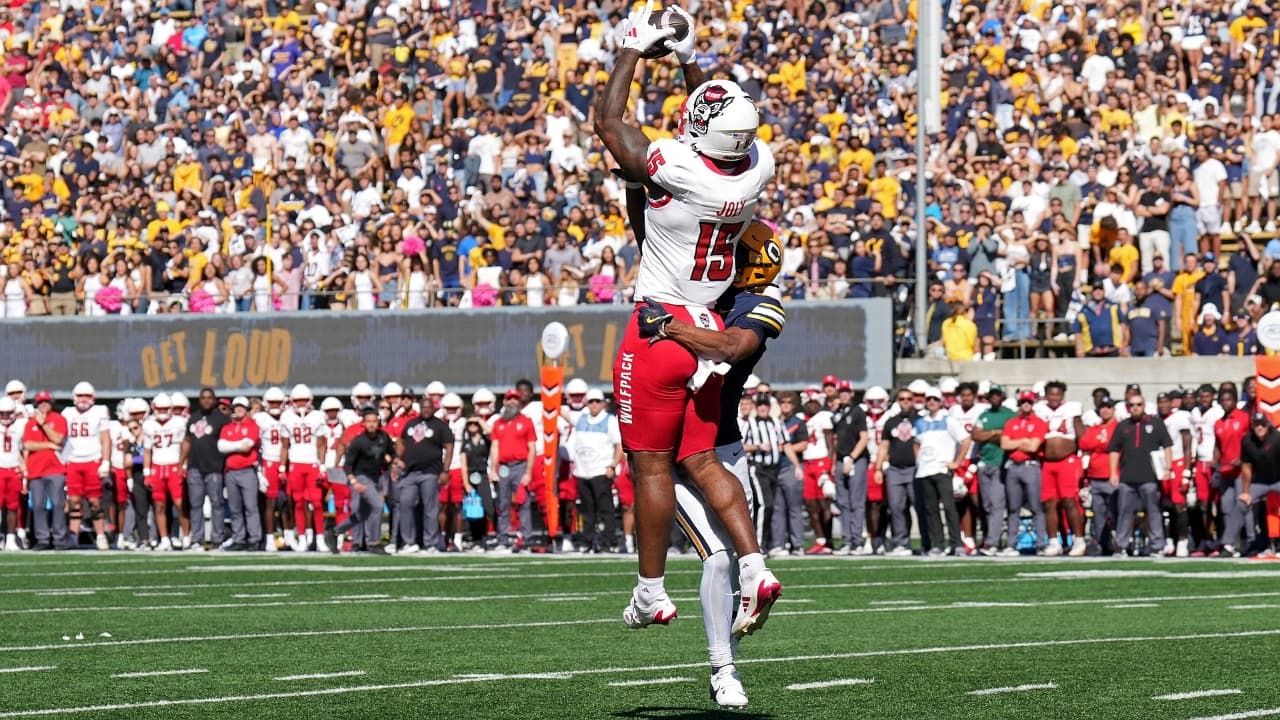
In this study, we will evaluate 22 wide receiver prospects in the 2026 NFL draft. The evaluations were done by benchmarking the last 3 seasons of college production against historical college stats for wide receivers drafted from 2021 to 2025.
Data Methodology
Data was manually collected from the college football sections of ESPN.com and Sports-Reference.com. The data collected includes:
Name
Height
Weight
TD
REC
YDS
90-199YDGAMES
200+YDGAMES
GP
TEAMPASSATT
TEAMPASSYARDS
TEAMREC
RUSHATT
RUSHYDS
RUSHTD
Data Preprocessing
From these stats, it was possible to calculate per game stats by dividing the variable of interest by "GP". This was done to calculate TD_per_game, YDS_per_game, REC_per_game, RUSHYDS_per_game, RUSHATT_per_game, and TEAMREC_per_game.
The same concept can be applied to touchdowns and receptions to calculate touchdowns per reception. Next, we divide the player's receptions by their team's receptions to estimate each player's target share per game.
Yards per carry (YPC) and yards per reception (YPREC) were calculated by dividing rush yards by carries and dividing receiving yards by receptions. I replaced any divide by zero errors in YPC using the replace command from Pandas. It was then converted from a string to a float using the to_numeric command from Pandas.
We converted height to inches by splitting the height at a single quote to obtain the values in feet and inches. The feet value is multiplied by 12 and added to inches before being converted to an integer.
Finally, the data is normalized using RobustScaler from Scikit-Learn to ensure equal feature weights during modeling.
Exploratory Data Analysis
Initially, I had my own logic of what made a wide receiver a strong prospect, which included most of my features. I attempted to create a K-Nearest Neighbors model from Sci-kit learn, but this logic failed because it was overfitting players on statistics rather than ability. I decided to create a correlation matrix using the corr function and Matplotlib to find features with strong relationships to optimize the model. The goal was to eliminate any variables with strong correlation coefficients (r> 0.65). I was able to narrow down the list of features to "YPREC", "YDS_per_game", "RUSHYDS_per_game", "Height_Inches", "Weight", "YPC", "TGTSHARE_per_game", "TD_per_rec". I removed 99-199 yard games and weight as features because they had strong relationships with receiving yards per game and height, which made them redundant. I also removed TD_per_game since it had a correlation coefficient of .80 with YDS_per_game.
Next, I removed 200+YDGAMES because there is too much noise involved with it. It skewed the results for certain prospects due to outlier games that were not near a player's normal production. These games were also accounted for in receiving yards per game, so it was a redundant feature that was causing bias. I also had the same issue with yards per carry and yards per reception. These were three variables of interest that I valued highly, but they are only valuable when tied to volume, so I was okay with not using them.
After analyzing the results for some time, I graphed certain features of interest using Plotly to determine the relationship between specific data points and really dive deeper into why certain players were neighbors. I was able to find that receiving yards per game, visualized with target share per game and receiving touchdowns per game, did a great job of modeling a player's production compared to their usage. Touchdowns per reception did not have a relationship that was as linear with receiving yards per game, so I decided to rebuild the model features.
First, I used yards per game and target share per game. and receiving touchdowns per reception. I added Height and RUSHYDS_per_game as additional features to account for a player's physical profile and usage. The results were strong, but a few players were still overfit on statistics. I then switched from receiving touchdowns per reception to receiving touchdowns per game, and the results almost captured the data in the same way the visualizations did.
The last step was removing height because it was homogeneous with any variable when visualized due to a lack of variation in player heights, which led to overfitting. The results using "YDS_per_game", "TD_per_game", "TGTSHARE_per_game", and "RUSHYDS_per_game" provided an accurate representation of a player’s situation, role, build, and production. I was able to build a player profile that I see as appropriately fit from their last 3 seasons of production in NCAA football. The model is limited because it does not account for opponent difficulty, drops, scheme, wins/losses, injuries, and measured intangibles (40-yard dash, routes run, contested catch rate).
Results
The model outputs current NFL players who match 2026 WR prospects, based on per-game production and team usage. The results were obtained using the Euclidean algorithm, which computes the straight-line distance between each NFL player and draft prospect for each feature. It does this by summing the squared differences between each prospect and each NFL player, then squaring the result to calculate the distance between the two across all features. The model returned the 5 NFL players who are closest in distance to each prospect.
Makai Lemon
1. Jaxon Smith-Njigba
2. Dyami Brown
3. Michael Pittman Jr.
4. Quentin Johnston
5. Drake London
Makai Lemon's production on his usage is near elite company, such as Jaxson Smith-Njigba, Jamarr Chase, and Travis Hunter. Outside of Dynami Brown, a majority of the players who profiled near Lemon are featured receivers on their respective NFL teams. Lemon's unquestionably a starting wide receiver in the NFL based on college statistics. His 2,008 yards on 137 targets over the last 3 seasons show he was more efficient than Jordan Tyson, who had 1,812 yards on 136 receptions during the same period. He broke out against Penn State in 2024 for 73 yards and has been consistent outside of two bad performances against Nebraska in both 2024 and 2025. When watching the film against Nebraska this past season, I saw a player who could have scored earlier in the game if his QB had kept his eyes up instead of looking to avoid a sack. Lemon later made some nice blocks to help his QB and RB score the team's 2nd and 3rd touchdowns to win the game, which shows his contribution to winning beyond just receiving yards. He is a top 10 pick with no chance of falling outside the top 16 in the draft.
Jordan Tyson
1. Tank Dell
2. Jalen Coker
3. Tetairoa McMillan
4. Jahan Dotson
5. Efton Chism III
Jordan Tyson was productive in college, but an injury caused him to miss some of his 2025 season. His receiving touchdowns, target share, and yards per game total were the best among all prospects. On film, he is explosive for a slot receiver and makes an extra effort to go after bad passes. Injuries are the concern with him. I viewed Tetairoa McMillan as a guaranteed star, which is why I want to be careful comparing him to Jordan Tyson. Tyson has a similar playstyle to Tet McMillan because of their size and versatility. Tank Dells' per-game stats over his last 3 seasons were the closest to Jordan Tyson in target share, yards, and touchdowns per game. Dell used his rare combination of speed and footwork, so I would say the comp is more about their ability to stretch the field from the slot and as an outside receiver. Jalen Coker is another comparison I like because of his build, route running, and reliability. Barring injuries, I see Tyson becoming a hybrid of Jalen Coker and Tank Dell, where he is a power slot with big-play ability. He is unarguably a starting receiver based on production and efficiency, and his range is somewhere between picks 11 and 21.
Carnell Tate
1. Xavier Leggete
2. Jordan Watkins
3. John Metchie III
4. Javon Baker
5. Tyler Scott
Most people will probably scoff at comparing Xavier Legette to Carnell Tate, but his per-game stats over his last 3 college seasons for receiving yards, touchdowns, and target shares were very close to Carnell Tate's. It's important to note that Legette played 5 seasons while Tate only played 3. I would say Legette was more dependent on straight-line speed, and his timing on jump balls was not as good as Tate's. John Metchie III might be the perfect comparison for Carnell Tate. Metchie was highly regarded coming out of Alabama, and the narrative surrounding him was that he was the next great receiver following Devonta Smith, Jaylen Waddle, Henry Ruggs, and Jerry Jeudy. He even won a national championship and had 916 yards on 55 receptions as a sophomore. Tate had 52 targets for 733 yards in 2 extra games as a sophomore on a national championship team, so Metchie actually outperformed him. I have a late 1st to early 2nd grade on Carnell Tate because the Ohio State pedigree is doing most of the heavy lifting, and the only thing giving me hope that he will be a number one receiver in the NFL.
Denzel Boston
1. Keon Coleman
2. Troy Franklin
3. Matthew Golden
4. Brian Thomas Jr.
5. Tee Higgins
Denzel Boston has a profile that aligns with borderline number one wide receivers known for being vertical threats. The players listed outside of Keon Coleman have been more suited as an NFL team’s second receiver due to inconsistency in their young careers, and I would not be surprised to see Boston follow a similar path, given his limited production in college compared to superstar receiver prospects. His per-game stats are nearly identical to Devontez Walker's, but the model did not match the two because Walker has usage in the run game. Boston’s experience as a kick returner at his size makes him a polarizing prospect. Overall, his physical profile and ability after the catch are the advantages Boston has over other WR prospects being considered here, and he should be viewed as a late first to early 2nd round pick.
KC Concepcion
1. Luke McCaffery
2. Khalil Shakir
3. Rondale Moore
4. Jalen Reagor
5. Savion Williams
K.C. Concepcion has an All-American season under his belt, and he can threaten a defense from anywhere on the field. From a target share and yards per game perspective, Concepcion stacks up with Demario Douglas, Luther Burden III, and Zay Flowers, all of whom have been contributors on NFL teams in some capacity. What Concepcion does similarly to prospects like Burden and Flowers is separate. The rushing stats skew his comparison towards receivers with production in that area, but Khalil Shakir is a good pro comp for Concepcion because both players are known for what they do after the catch. Concepcion has all the tools to develop into an NFL team’s featured receiver. He should have his name called between picks 20 and 42.
Elijah Sarratt
1. Jayden Higgins
2. Jahan Dotson
3. A.T. Perry
4. Denzel Mims
5. Josh Downs
Elijah Sarratt’s touchdowns and yards per game production fell near A.T. Perry, who had an extremely productive career at Wake Forest. His overall production was on par with Jayden Higgins and Jahan Dotson, both of whom were drafted within the first 35 picks of the draft. It’s hard to find someone with Sarratt’s touchdown production and size who isn’t known for being a vertical threat. Jayden Higgins is the comparison I would lean on for this reason. Higgins is more of a reliable number 2 receiver, who works the intermediate part of the field and has good touchdown production in college. It’s important to note that two receivers in this range of production, who were not highly touted during their drafts, are Amon-Ra St.Brown and Justin Jefferson. Sarratt should hear his name called in the 2nd round of the draft.
Chris Brazzell
1. KeAndre Lamber-Smith
2. Tyquan Thornton
3. Alec Pierce
4. Dontayvion Wicks
5. Pat Bryant
Chris Brazzell is a beneficiary of playing in a WR-friendly scheme, which is why I like the comparison to Tyquan Thornton and Pat Bryant. All three players can stretch the field and use their catch radius to come down with contested catches. Alec Pierce has a similar profile, but he has a far superior athletic profile, which gives him a boost over the rest of this list. Brazzell’s inability to pick up extra yards after the catch does not inspire me to have trust in him as a number one option for a competitive team. I have a 3rd round grade for him, but he should go as high as 2nd round since teams usually bite on this kind of player often.
Antonio Williams
1. Garrett Wilson
2. Ricky Pearsall
3. Jaylin Lane
4. Ladd McConkey
5. Luther Burden III
If I were to recommend one receiver in this draft to any franchise, it would be Antonio Williams. His college profile lines up well with multiple productive pro receivers, and his film is the best of any WR prospect in this draft. Ricky Pearsall is a decent comparison for Antonio Williams because he is effective as a runner and deep threat. Jameson Williams is my personal pro comp for him because both players can open up the playbook by stretching the field vertically and laterally on play-action, screens, end-arounds, and flea flickers. I have Antonio Williams as a top 20 pick, and I would not be surprised if he ends up being the second receiver off the board behind Makai Lemon. He will be a star by the end of his rookie season, regardless of team.
Chris Bell
1. Kaden Prather
2. Parker Washington
3. Chime Dike
4. Ainias Smith
5. Dominic Lovett
Chris Bell was neck in neck with Chris Brazzell in target share and yards per game. He is known for his speed, which could explain why he was close to Chime Dike’s overall profile. His ability to pick up yards after the catch mirrors what Parker Washington did in college, but Bell’s lack of snaps in the slot concerns me. He is strictly an outside receiver based on his college career, which will only limit his opportunities to see the field in the NFL. I have him being a day 2-3 pick, and a high-end number 3 receiver. If he can play in the slot, he has the potential to develop into a really good player.
Omar Cooper Jr.
1. Roman Wilson
2. Brendan Rice
3. Trey Palmer
4. Jermaine Burton
5. Charlie Jones
Omar Cooper Jr. is a tricky prospect because he was not consistent outside of his 200-yard game. Roman Wilson does not fit him as a comparison in terms of playstyle, but I would like you to think about it differently here. Both players were on National Championship teams that scored a lot of touchdowns, which explains the high touchdowns and low receiving yards per game averages. Cooper Jr. performed better as a receiver than Roman Wilson, so let’s throw this comparison in the garbage beyond the team environment and role. My concern here is that he is another Treylon Burks, who was a first-round pick that excelled in getting yards after the catch. This is because, according to Stampede Blue (An Indianapolis Colts Community), Cooper Jr. had 494 yards after the catch. This means he has at most 443 receiving yards from actually catching passes from all over the field, and when you divide that by his 69 receptions, you learn that he really averaged 6.4 yards per catch. This, along with the inconsistency and inflated touchdown numbers, makes me question his ability to be an effective threat beyond designed plays. Omar Cooper Jr. will likely be a day 3 pick, but I do not see him being more than a 3rd receiver on a team.
Germie Bernard
1. Jaylin Lane
2. Erik Ezukanma
3. Ladd McConkey
4. Jimmy Horn Jr.
5. Ricky Pearsall
Germie Bernard is an under-the-radar receiver who should have a good NFL career as a number two receiver or borderline number one receiver. He showed great consistency in 2024 and 2025, where he had 40 or more scrimmage yards in 23 of his possible 27 games. Bernard gives offensive coordinators some creative ways to run the football, and he would fit a run-heavy team that uses a lot of play action. Although some of his receiving yards are after the catch, like Omar Cooper Jr., Bernard’s route running, lateral quickness, and footwork are too strong to ignore. He is a must draft on day 2, and he would be a great fit for Buffalo or Cleveland in the first round.